
Quick Summary
Self-publishing children's books on Amazon KDP remains one of the most accessible entry points into online publishing in 2026. By combining AI writing assistance with AI illustration tools, you can create professional-quality picture books without artistic skills or a massive budget. The key to profitability lies in volume, niche selection, and understanding that this is a business—not a get-rich-quick scheme. Expect to publish 5-10 books before seeing consistent monthly income.
Can you really make money with this in 2026?
As of early 2026, the children's book market on Amazon generates approximately $3.2 billion annually, with self-published titles capturing an increasingly significant share. The honest answer is yes—you can make real money when you self publish childrens books—but the landscape has matured considerably.
Three years ago, throwing up a mediocre AI childrens book could generate sales through sheer novelty. That window has closed. Amazon's algorithm now rewards quality engagement metrics, and parents have become savvier about spotting low-effort content. The creators still profiting in 2026 treat this as a legitimate publishing business.
The good news? The tools have improved dramatically. AI can now illustrate childrens book pages with consistent character designs across spreads—something that was nearly impossible in 2023. Writing assistance has evolved beyond generic outputs to understand age-appropriate vocabulary, pacing, and emotional beats that actually resonate with young readers.
Real publishers in this space report earning anywhere from $200 to $15,000 monthly, with the median falling around $800-1,500 for those with 10+ active titles. The top earners aren't necessarily better writers—they're better at identifying underserved niches and publishing consistently.
How self-publishing children's books actually works
The mechanics are straightforward once you understand the ecosystem.
Amazon KDP (Kindle Direct Publishing) serves as your storefront, printer, and distributor. When someone orders your book, Amazon prints it on demand, ships it, handles customer service, and deposits your royalty. You never touch inventory.
For childrens book kdp publishing, you'll typically create paperback picture books. The royalty structure pays you 60% of the list price minus printing costs for expanded distribution, or a fixed rate for KDP-only distribution. A 32-page color picture book priced at $12.99 nets roughly $2.50-4.00 per sale depending on your distribution choices.

The creation process involves four core phases:
Writing: Developing a story appropriate for your target age group (typically 300-800 words for picture books).
Illustration: Creating 12-16 full-color illustrations that match your narrative beats.
Formatting: Laying out your book to KDP's specifications (proper bleed, margins, and page count requirements).
Publishing: Uploading files, writing your product description, selecting categories, and setting your price.
The entire process can take anywhere from a weekend (using AI tools extensively) to several months (with traditional illustration). Your approach determines both your timeline and your cost structure.
Step-by-step: how to start
Step 1: Research profitable niches before writing anything
This step separates hobbyists from earners. Don't write the book you want to write—write the book parents are already searching for.
Use Amazon's search bar to explore. Type "children's books about" and note the autocomplete suggestions. These represent actual search volume. Look for specific topics like "children's books about starting kindergarten" or "children's books about big emotions" rather than generic themes.
Analyze the competition. Search your potential topic, then evaluate the top 20 results. If they're all from major publishers with hundreds of reviews, the niche is saturated. If you see self-published books with 20-100 reviews ranking on page one, there's opportunity.
Check the Best Sellers Rank (BSR) of competing books. Anything under 100,000 BSR in Books indicates consistent daily sales. Under 50,000 means multiple daily sales.
Step 2: Develop your story concept and outline
Children's books succeed on concept clarity. Your book should be explainable in one sentence: "A shy dragon learns to make friends at a new school" or "A little girl discovers her bedtime fears aren't so scary."
Map your narrative to the standard picture book structure:
- Pages 1-4: Introduce protagonist and their world
- Pages 5-8: Present the problem or desire
- Pages 9-20: Escalating attempts to solve the problem
- Pages 21-28: Climax and resolution
- Pages 29-32: Satisfying conclusion with emotional payoff
For faster development, Book Engine can generate complete children's book manuscripts calibrated for specific age groups. The platform understands picture book pacing and can produce KDP-ready content that you then customize with your unique creative direction.
Step 3: Write age-appropriate content
Word count matters more than you think. Here's the breakdown by age:
- Board books (0-3): 100-300 words, simple concepts, repetition
- Picture books (3-7): 400-800 words, clear narrative arc
- Early readers (5-8): 1,000-2,500 words, simple chapters
Vocabulary must match comprehension levels. A book for 4-year-olds shouldn't include words like "magnificent" or "determined" unless you're intentionally introducing them with context.
The most successful children's book authors don't write down to kids—they write directly to them, respecting their intelligence while meeting them at their developmental level.
Read your manuscript aloud. Children's books are meant to be read aloud, and awkward phrasing becomes immediately obvious when spoken. If you stumble, rewrite.
Step 4: Create your illustrations with AI
This is where 2026 tools shine. To illustrate childrens book ai style, you'll use image generation platforms like Midjourney, DALL-E 3, or Leonardo.ai.
The critical skill is prompt engineering for consistency. You need the same character looking recognizable across 15+ images. Modern techniques include:
- Creating a detailed character reference sheet first
- Using consistent style prompts ("whimsical watercolor style, soft edges, warm palette")
- Generating multiple variations and selecting the most cohesive set
- Using image-to-image features to maintain character consistency
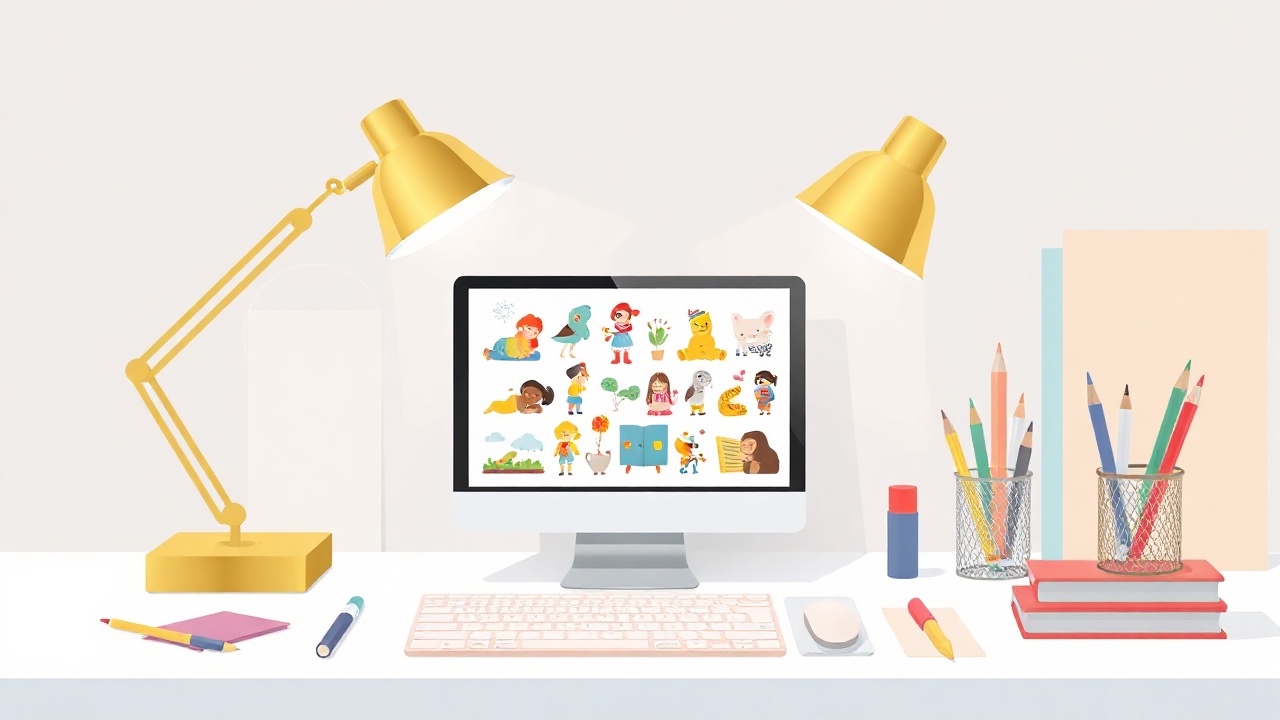
Plan your illustration list before generating. Each spread needs a visual that advances the story. Sketch rough thumbnails (stick figures are fine) to plan compositions before spending time on AI generation.
Step 5: Format and assemble your book
KDP has specific requirements:
- Trim size: 8.5" x 8.5" is the most popular for picture books
- Bleed: 0.125" on all sides for images extending to edges
- Page count: Must be divisible by 2, minimum 24 pages
- File format: PDF with embedded fonts and flattened images
Use Canva, Adobe InDesign, or Affinity Publisher to assemble your pages. KDP provides free templates for every trim size. Download these first—they include proper margin guides.
Export your interior as a print-ready PDF. For the cover, KDP's cover calculator generates a template based on your page count and paper type. Your spine width changes with page count, so don't create your cover until your interior is finalized.
Step 6: Optimize your Amazon listing
Your product page sells the book. Key elements:
Title: Include your main keyword naturally. "Luna's First Day: A Children's Book About Starting School" works better than a clever-but-vague title.
Description: Write for parents, not kids. Address the problem your book solves. Use HTML formatting (bold, line breaks) to improve readability.
Categories: Select two categories. Choose the most specific relevant options—better to dominate a small category than disappear in a large one.
Keywords: You get seven keyword slots. Use phrases, not single words. "books about anxiety for kids" outperforms "anxiety."
For compelling descriptions that convert browsers to buyers, Content Engine can generate optimized product copy that hits emotional triggers parents respond to while naturally incorporating searchable phrases.
Step 7: Launch and build momentum
Your book's first 30 days determine its long-term trajectory. Amazon's algorithm favors velocity—the faster you accumulate sales and reviews, the more visibility you receive.
Proven launch tactics:
- Price at $0.99-2.99 for the first week to drive volume
- Enroll in KDP Select to access Kindle Unlimited readers
- Request honest reviews from your network (Amazon allows this if no compensation is exchanged)
- Run Amazon Ads starting at $5-10/day with automatic targeting
Realistic earnings & timeline
| Stage | Timeline | Expected Monthly Revenue | Books Published |
|---|---|---|---|
| Learning phase | Months 1-2 | $0-50 | 1-2 |
| Building inventory | Months 3-6 | $50-300 | 3-6 |
| Gaining traction | Months 7-12 | $300-800 | 7-12 |
| Established publisher | Year 2+ | $800-3,000+ | 15-30+ |
These numbers assume consistent publishing, basic marketing, and reasonable niche selection. Outliers exist in both directions—some books flop completely while others become unexpected hits generating $2,000+ monthly from a single title.
The compounding effect is real. Each book becomes a potential customer acquisition channel for your other books. Publishers with 20+ titles often see their entire catalog lift when one book gains visibility.
Mistakes that kill beginners
Rushing illustration consistency: Nothing screams "amateur" like a character whose appearance changes every page. Invest the extra time to regenerate images until your protagonist looks cohesive throughout. Parents notice, and they'll leave reviews about it.
Ignoring age-appropriate vocabulary: Using words too advanced for your target age group frustrates parents during read-aloud sessions. They won't buy your next book. Use tools like the Flesch-Kincaid readability score to verify appropriateness.
Choosing oversaturated niches: Competing with 10,000 "bedtime story" books as your first publication is setting money on fire. Find the underserved angles—bedtime stories for kids afraid of the dark, or specifically about kids who won't stay in bed.
Publishing one book and waiting: A single title is a lottery ticket, not a business. The publishers earning consistent income treat this as a catalog game. Use Book Engine to maintain a sustainable publishing cadence without burning out on the writing process.
Neglecting your book description: Parents can't flip through your book online. Your description must convey the experience, the value, and the emotional payoff. A weak description kills conversions regardless of how good your actual book is.
Frequently asked questions
How much does it cost to self publish a children's book on Amazon?
Publishing on Amazon KDP is free. Your main costs are illustration (free to $2,000+ depending on method), ISBN (free through KDP or $125 for your own), and optional marketing. Most AI-assisted creators spend under $100 total to publish their first book.
Can you use AI to illustrate children's books legally?
Yes, you can legally use AI-generated illustrations in commercial children's books. However, AI art currently cannot be copyrighted in the US, meaning only your text receives copyright protection. Many successful publishers use AI illustrations without legal issues.
How many pages should a children's book be for KDP?
Most children's picture books range from 24-32 pages, which is the industry standard. Board books for toddlers can be shorter (10-20 pages), while early reader chapter books run 40-80 pages. KDP requires a minimum of 24 pages for paperback picture books.
How long does it take to make money from self-published children's books?
Most publishers see their first sales within 2-4 weeks of publishing. However, meaningful monthly income ($500+) typically takes 6-12 months and requires multiple titles. A single book rarely generates substantial ongoing revenue.
What age group sells best for self-published children's books?
Picture books for ages 3-7 and early readers for ages 5-8 tend to sell best for self-publishers. These age groups have consistent demand, parents actively search for new content, and the shorter format makes production faster and more affordable.
The bottom line
The opportunity to self publish childrens books profitably in 2026 is real, but it rewards patience and volume over quick wins. Treat this as a long-term publishing business, leverage AI tools to maintain sustainable production, and focus obsessively on serving specific reader needs rather than chasing trends. The creators building genuine income streams are the ones who publish consistently, learn from their data, and keep improving with every title.
Get the AI tools to do all of this — free
Create a free Elite Engines account and get 5 AI money-making engines instantly. No credit card.