Quick Summary
The resume template business remains one of the most accessible digital product ventures for designers in 2026. You create editable resume templates once, list them on Etsy and your own store, and earn passive income every time someone downloads. This guide covers the complete process—from designing ATS-friendly templates to pricing strategy and scaling beyond your first hundred sales.
Can you really make money with this in 2026?
As of early 2026, the resume template market generates an estimated $380 million annually across platforms like Etsy, Creative Market, and independent stores. The demand driver is simple: approximately 6.5 million Americans change jobs each month, and most need updated resumes. Add international markets—particularly the UK, Canada, Australia, and increasingly Southeast Asia—and you have a constantly replenishing customer base.
Etsy alone processes over 2.3 million searches for "resume template" monthly. The platform's digital downloads category grew 23% year-over-year in 2025, with resume templates consistently ranking in the top five subcategories. This isn't a saturated gold rush that's dried up; it's a mature market with proven demand and room for differentiated sellers.
The economics work because your marginal cost is zero. Design a template once, and every sale after that is nearly pure profit (minus platform fees). Top Etsy resume sellers report 70-85% profit margins after accounting for fees, design tools, and occasional virtual assistant help.
What's changed in 2026 is the sophistication required. Generic, cluttered templates don't cut it anymore. Buyers expect ATS (Applicant Tracking System) compatibility, multiple file formats, and designs that balance professionalism with visual appeal. If you can deliver that, you can absolutely build a sustainable income stream.
How selling resume templates actually works
The business model is straightforward once you understand the moving parts.
You design resume templates using software like Canva, Adobe InDesign, Microsoft Word, or Figma. Each template becomes a digital product—a set of files the buyer downloads and edits with their own information. You're not selling the design itself; you're selling convenience and professional appearance.
Your primary sales channel is Etsy, which handles payment processing, provides built-in search traffic, and manages customer disputes. Etsy charges a $0.20 listing fee, 6.5% transaction fee, and 3% + $0.25 payment processing fee. On a $12 template, you net roughly $10.50.
Your secondary channel is your own store—typically Shopify, Gumroad, or Payhip. Here you keep more revenue (Gumroad takes around 10% total, Shopify charges your payment processor rate plus subscription) and build a customer list for upsells and repeat purchases.
The customer journey looks like this:
- Job seeker searches "modern resume template" on Etsy or Google
- They see your listing, click through, review mockups and reviews
- They purchase and immediately receive download links via email
- They edit the template with their information and apply to jobs
- If satisfied, they leave a review and possibly buy matching cover letters or LinkedIn banners
Your job is to create templates that rank well in search, convert browsers into buyers, and deliver enough value that reviews stay positive. Reviews compound—a listing with 500 five-star reviews will outsell a nearly identical template with 50 reviews, even at a higher price.
Step-by-step: how to start your resume template business
1. Research the market before designing anything
Spend a full week studying what's already selling. Search Etsy for "resume template," "modern resume," "minimalist CV," and industry-specific terms like "nurse resume template" or "software engineer CV." Sort by bestsellers and note patterns:
- What color schemes dominate? (In 2026, it's still muted tones—navy, forest green, warm gray—with occasional bold accents)
- What layouts get reviews mentioning "easy to edit" or "got me interviews"?
- What price points cluster the bestsellers? (Typically $8-15 for single templates, $18-35 for bundles)
- What complaints appear in negative reviews? (Usually: hard to edit, not ATS-friendly, missing promised formats)
Document at least 30 successful listings. You're not copying—you're understanding what the market rewards.
2. Choose your niche and design angle
Generic templates compete against thousands of established sellers. Niching gives you a fighting chance.
Strong niches in 2026 include:
- Industry-specific templates (healthcare, legal, creative, tech, academia)
- Career-stage templates (entry-level, mid-career, executive)
- Aesthetic niches (minimalist, bold modern, creative maximalist)
- Format specializations (ATS-optimized, career-change resumes, skills-based layouts)
Pick a niche where you have some knowledge or genuine interest. If you've worked in healthcare, you understand what nurse managers want to see on a resume. That insight translates into better products.
3. Create your first 5-10 templates
Start with a manageable collection. Design in your primary software (Canva Pro is the most accessible; InDesign offers more control), then export to multiple formats.
Every template should include:
- Microsoft Word version (.docx)—non-negotiable, this is what most buyers want
- Google Docs version (linked template they can copy)
- PDF preview showing the completed design
- Canva template link if you designed there
- Brief instruction guide explaining how to edit
ATS compatibility matters enormously. Avoid text boxes, tables, headers/footers for crucial information, graphics that overlap text, and unusual fonts. Test your templates through free ATS simulators like Jobscan or ResumeWorded.
The sellers who dominate aren't necessarily the best designers—they're the ones who obsess over making their templates genuinely easy to edit and effective at getting interviews.
4. Create listings that actually convert
Your Etsy listing needs to work harder than your design. A beautiful template with poor listing optimization will languish unseen.
Title: Front-load keywords. "Resume Template | ATS-Friendly | Modern CV for Word & Google Docs | Professional Resume Design | Instant Download" covers multiple search terms.
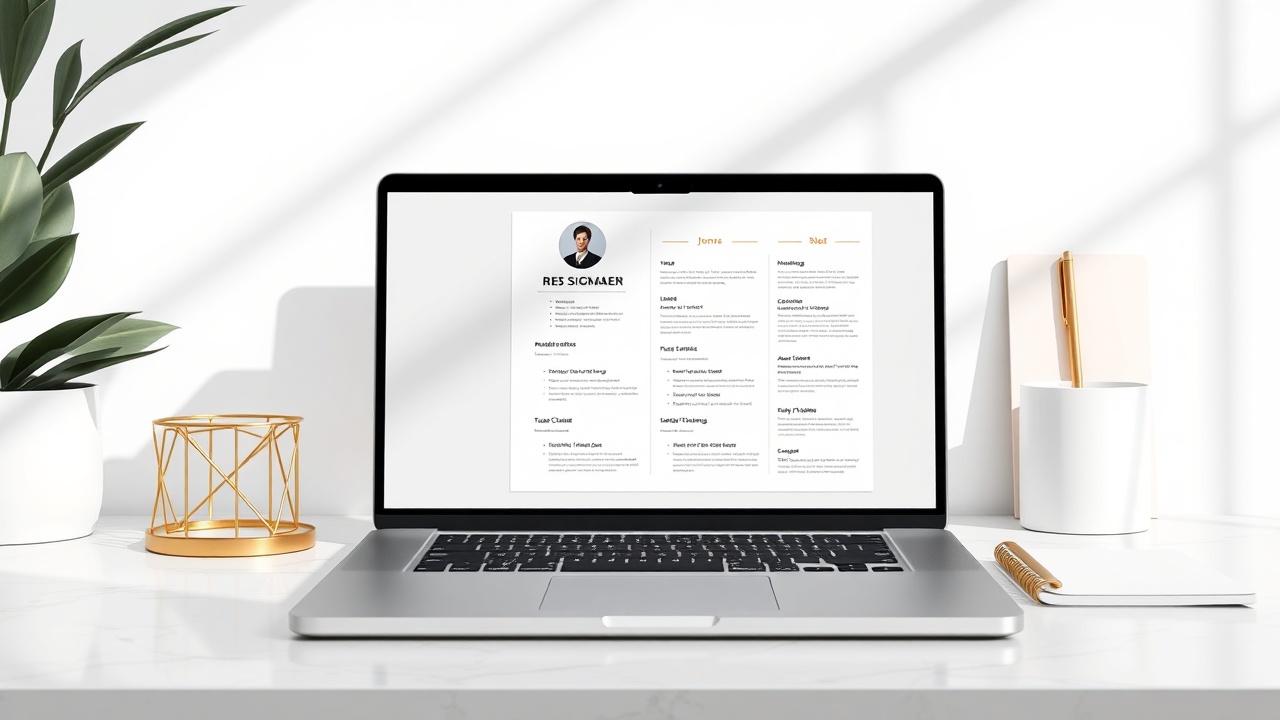
Images: Create 8-10 mockup images showing the template in various contexts—on a desk, on a laptop screen, with close-ups of sections, with the different color variations you offer. The first image must stop the scroll.
Description: Lead with benefits ("Land more interviews with a clean, ATS-optimized design"), then cover what's included, how to edit, and FAQ-style answers to common concerns.
This is where many designers get stuck—they can create beautiful templates but struggle with the marketing assets. The Etsy Engine can help you generate optimized listing content, mockup concepts, and keyword-rich descriptions that match what's actually working on the platform. It's particularly useful for translating your design into the commercial language Etsy rewards.
5. Price strategically
New sellers often underprice. A $5 template signals low quality; an $8-12 template signals accessible professionalism; a $15-20 template signals premium.
For bundles (3-5 coordinated templates plus cover letters), $25-45 is the sweet spot. Bundles have higher perceived value and higher average order value.
Consider a tiered approach:
- Single template: $10-12
- Template + matching cover letter: $15-18
- Full bundle (3 templates, cover letters, reference page, LinkedIn banner): $35-45
6. Launch and build initial reviews
Your first 20 reviews determine your trajectory. Options to accelerate:
- Price your first template at $5-7 temporarily to generate volume and reviews
- Offer the template free or discounted to friends/family who will leave honest reviews
- Run Etsy Ads at $1-3/day on your best listing to boost visibility
Respond to every customer message within 24 hours. Quick, helpful responses lead to better reviews and repeat buyers.

7. Expand to your own store
Once you have 3-5 listings generating consistent sales, set up your own Shopify, Gumroad, or Payhip store. This gives you:
- Higher margins (no 6.5% Etsy transaction fee)
- Customer email addresses for marketing
- Freedom to bundle and price without platform constraints
- A hedge against Etsy algorithm or policy changes
Drive traffic to your store through Pinterest (create pins for each template), a simple blog with resume tips, and including a store link in your Etsy packaging.
8. Scale with content and SEO
The long game involves building organic traffic beyond Etsy. A blog with articles like "Best Resume Formats for Career Changers" or "How to Write a Software Engineer Resume in 2026" attracts job seekers who may then purchase your templates.
Creating consistent, SEO-optimized content is time-intensive, but tools like the Content Engine can help you publish long-form articles systematically. This compounds—each article becomes a permanent traffic source pointing back to your resume template store.
Realistic earnings & timeline
| Timeline | Listings | Monthly Revenue | Notes |
|---|---|---|---|
| Month 1-3 | 5-10 | $0-200 | Building, learning, first reviews |
| Month 4-6 | 15-25 | $200-500 | Gaining traction, optimizing |
| Month 7-12 | 30-50 | $500-1,500 | Compounding reviews, expanding |
| Year 2 | 50-100 | $1,500-4,000 | Established seller, diversified |
| Year 3+ | 100+ | $3,000-10,000+ | Multiple platforms, strong brand |
These numbers assume consistent effort—publishing new templates monthly, optimizing underperformers, and responding to market trends. Passive income in this business means passive delivery, not passive creation and marketing.
Top-tier sellers earning $10,000+ monthly typically have been in the game 2-3 years, have 150+ listings across platforms, and have built substantial Pinterest and blog traffic funnels.
Mistakes that kill beginners
1. Ignoring ATS compatibility. The most beautiful template is worthless if applicant tracking systems can't parse it. Your gorgeous design with text boxes and creative layouts gets rejected before human eyes ever see it. Test every template through ATS simulators.
2. Weak mockups and listing images. Buyers can't touch your product; they judge entirely by your images. Fuzzy mockups, plain white backgrounds, or showing only the template without context tanks your conversion rate. Invest time in realistic, professional presentation.
3. Offering only one file format. Some buyers need Word. Others only use Google Docs. Some want Canva. Limiting formats limits your audience. The extra hour exporting to multiple formats pays dividends on every sale.
4. Pricing based on time spent, not value delivered. A template that takes you 3 hours isn't worth $30 because you spent 3 hours. It's worth what buyers will pay for the outcome—a professional resume that helps them land interviews. Price for value, not effort.
5. Abandoning after slow early sales. The resume template business has a long ramp. Your first two months will feel discouraging. Sellers who quit at month three miss the compounding that happens at months six through twelve. Consistent publishing and optimization eventually breaks through.
Frequently asked questions
How much can you realistically make selling resume templates?
Most beginners earn $200-$800 per month in their first year. Established sellers with 50+ optimized listings often reach $2,000-$5,000 monthly. Top performers with diversified platforms and strong SEO can exceed $10,000 per month, though this typically takes 18-24 months to achieve.
Do I need design experience to sell resume templates?
Basic design skills help, but you don't need professional experience. Tools like Canva have lowered the barrier significantly. What matters more is understanding what hiring managers and job seekers actually want—clean layouts, ATS compatibility, and easy editing. Many successful sellers learned design specifically for this business.
Is the resume template market oversaturated in 2026?
The market is competitive but far from saturated. Job seekers continuously enter the market, and design trends evolve constantly. Success comes from niching down—targeting specific industries, career levels, or aesthetics rather than competing on generic templates. Specialized templates for tech, healthcare, or executive roles still have strong demand with less competition.
What file formats should I offer for editable resume templates?
Offer multiple formats to maximize your audience. Include Microsoft Word (.docx) as your primary format since most job seekers use it. Add Google Docs links for cloud-based editing, Canva template links for design-focused buyers, and PDF versions for reference. Some sellers also include Apple Pages and InDesign files for premium bundles.
Should I sell resume templates on Etsy or my own website?
Start with Etsy to leverage its built-in traffic and validate your designs. Once you have proven sellers, expand to your own Shopify or Gumroad store where you keep more profit (no 6.5% Etsy fees) and own your customer relationships. The ideal 2026 strategy is both—Etsy for discovery, your store for repeat buyers and higher margins.
The bottom line
The resume template business rewards designers who understand that they're not selling aesthetics—they're selling job seekers confidence and convenience. Build editable resume templates that are genuinely easy to customize and effective at passing ATS systems, and the market will find you. It's not fast money, but it's real money, and it compounds with every listing you publish and every review you earn.
Get the AI tools to do all of this — free
Create a free Elite Engines account and get 5 AI money-making engines instantly. No credit card.